Typically, most people don’t think about slip resistance on their concrete until someone actually slips. Consider a wet pool deck in July, or a garage floor that gets slick every time a Florida afternoon storm blows rain through the door. Likewise, a patio can turn into a skating rink the moment the sprinklers run. These are not rare situations in the 813 area; in fact, they happen constantly, and the concrete around most Tampa homes simply isn’t prepared for them.
Therefore, this guide covers where non-slip coating actually matters, how slip resistance gets built into a proper coating system, and why the timing of when you address it makes a bigger difference than most homeowners expect.
Why Tampa’s Outdoor Concrete Is a Slip Problem Waiting to Happen
Florida’s unique climate creates specific conditions that make uncoated or poorly coated concrete genuinely dangerous when wet.
- Daily afternoon rain from June through September: Tampa averages more than 46 inches of rain per year, with most of it concentrated in summer months. Consequently, outdoor concrete around pools, patios, and driveways gets wet repeatedly, often multiple times a day during the wet season.
- Pool splash and surrounding deck traffic: People getting in and out of a pool track water across the deck constantly. On smooth or worn concrete, that creates a major slip hazard, especially for kids running between the pool and the house.
- Morning dew on exposed surfaces: Even on completely dry days, Tampa’s high humidity means outdoor concrete surfaces that haven’t fully dried from the night before can remain slick in the early morning hours.
- Garage floors when it rains: Wind-driven rain comes straight into open garage doors during severe Tampa storms. As a result, a smooth epoxy or unsealed concrete garage floor becomes a slip hazard the exact moment rain tracks in on shoes or tires.
- Condensation on indoor concrete: In Florida’s humid climate, temperature differences between air-conditioned interiors and exterior slabs cause condensation to form on concrete surfaces. This is particularly common in garages and enclosed lanais.
None of these situations is unusual, as they are just part of living in Tampa. Fortunately, they are all completely manageable with the right coating and the correct finish.
Where Non-Slip Coating Actually Matters Around a Tampa Home
Not every concrete surface carries the exact same slip risk. Here is where proper traction matters most:
Pool Decks
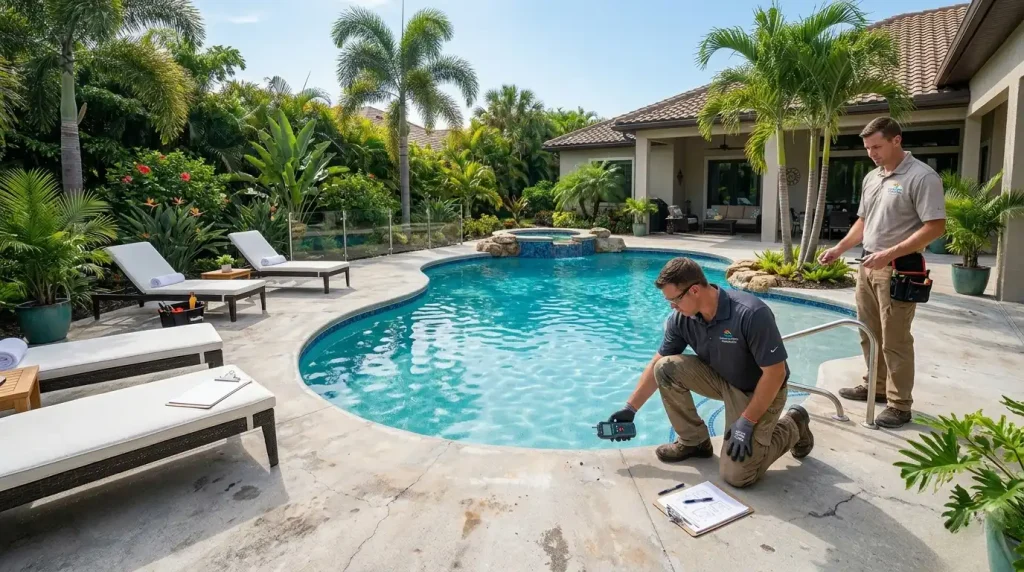
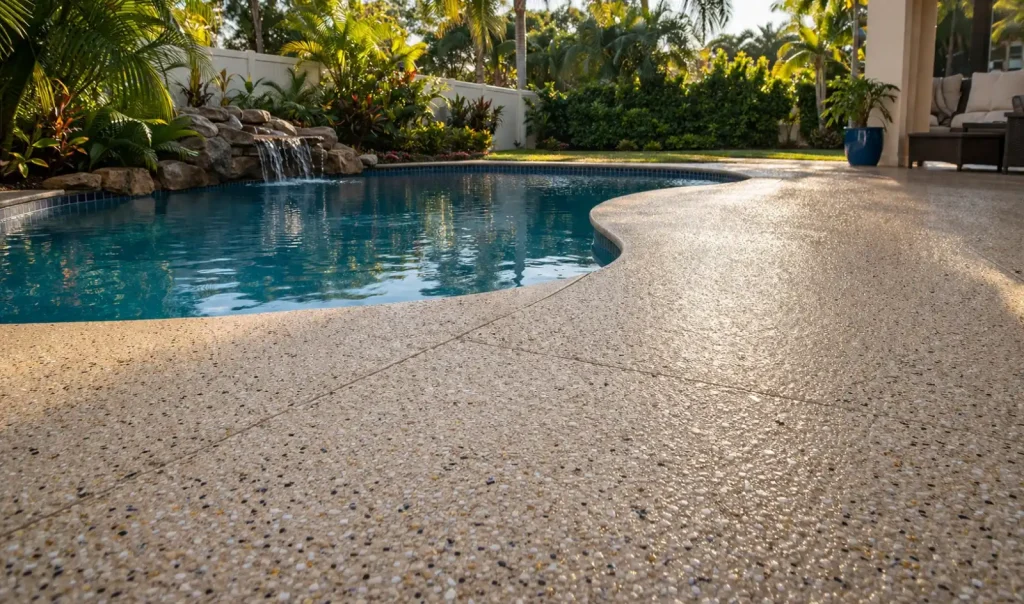
Without a doubt, this is the highest-risk surface for slips around most Tampa homes. Wet feet on smooth or worn concrete around a pool deck is one of the most common causes of preventable injuries in residential settings. Slip resistance on a pool deck coating isn’t simply something that gets added on top of a finished surface. Instead, it needs to be broadcast directly into the coating during application. A texture aggregate gets embedded into the wet coating before the topcoat goes down, which means the grip is permanently built into the surface rather than just sitting on top of it. Ultimately, a coating applied without slip-resistant texture on a Tampa pool deck is a serious safety problem, not just an aesthetic oversight.
Patios and Covered Lanais
Covered lanais create a highly specific problem because they stay damp much longer than open surfaces. Rain blows in, but direct sun cannot dry them out quickly. Furthermore, shaded areas tend to grow algae and mold on porous, unsealed concrete, causing it to become slick even when it looks dry. A proper patio and lanai coating with slip-resistant texture effectively addresses both the moisture retention problem and the algae growth by sealing the surface completely. Consequently, having no porous concrete means there is nowhere for mold to take root.
Garage Floors
Garage floors in Tampa deal with wind-driven rain, vehicle moisture, and heavy Florida humidity year-round. A smooth epoxy garage floor that looks stunning on a dry day quickly becomes genuinely slick during a storm. The solution isn’t avoiding epoxy or polyaspartic altogether. Rather, it involves making sure the right texture is broadcast into the system during installation. Most professional garage floor coating installations include a color flake broadcast that naturally adds texture and grip to the surface. However, the problem occurs when the flake layer is sealed too heavily, which fills in the texture that was originally supposed to provide grip.
Driveways
Driveways in Tampa get wet constantly during the rainy season. For instance, a steeply pitched driveway with a smooth coating becomes incredibly difficult to walk on when wet, turning into a safety concern for anyone carrying items to or from their car. A high-quality driveway coating with slip-resistant texture built into the topcoat addresses this issue entirely without affecting the appearance of the finished surface. As a result, the necessary grip is present without looking overly industrial or out of place at the front of a beautiful South Tampa or Westchase home.
How Slip Resistance Gets Built Into a Coating and Where It Goes Wrong
This is exactly where the difference between a properly installed coating and a cheap budget job shows up in ways that truly matter.
- Aggregate broadcast during application: Slip-resistant texture is added by broadcasting a fine aggregate into the wet coating right before the topcoat goes down. This process embeds the texture deep into the surface so it becomes a permanent part of the coating rather than a temporary layer on top of it.
- The topcoat seal matters: If the topcoat is applied too heavily over the aggregate layer, it fills in the texture and severely reduces the overall grip. This is a very common problem on budget installations where the topcoat is applied strictly for appearance rather than actual performance. The floor might look good, but it completely fails to provide the traction the aggregate was supposed to create.
- Surface prep determines how long it holds: A slip-resistant coating applied over improperly prepared concrete will eventually start to peel or lift. When that delamination happens, the texture goes right with it. Proper diamond grinding and rigorous moisture testing before installation are exactly what determine whether the coating and its essential slip resistance will hold up long term.
What Happens When Homeowners Wait Too Long
The pattern we observe across Tampa Bay is highly consistent. First, a homeowner notices the pool deck is getting slick. They tell themselves they will deal with it after summer is over. Then, the next summer arrives, nothing has changed, and sadly, someone slips.
On the other hand, the other version involves a homeowner who had a coating applied by a contractor who completely forgot to include slip-resistant texture, or who applied the topcoat too heavily and buried whatever texture was previously there. Once again, the floor looks fine visually but completely fails to grip when wet.
In both scenarios, the proper fix requires a full assessment of the current surface condition, a clear recommendation on what the slab truly needs, and a meticulous installation that actually prioritizes performance in Florida’s wet conditions, not just appearance.
For example, properties in Brandon and Riverview that have enclosed pool areas or covered lanais are particularly prone to moisture retention issues. Meanwhile, properties in Westchase with strict HOA requirements often need a solution that provides superior grip without changing the visual character of the original surface. Both situations are completely addressable, but the final approach always depends on what the specific surface actually needs.
Questions to Ask Before Any Non-Slip Coating Job in Tampa
To protect yourself and your property, always ask these crucial questions before hiring a contractor:
- Is slip-resistant aggregate included in the system? It should always be a standard feature, not an expensive add-on. If a contractor doesn’t explicitly mention it, make sure to ask directly.
- How is the topcoat applied over the texture layer? Too heavy of a topcoat buries the aggregate and reduces grip. Always ask how the contractor manages topcoat thickness to properly preserve the texture.
- What surface prep method is used? Diamond grinding is the absolute industry standard. A mechanically prepared surface holds the coating and its texture much longer than a surface that was only lightly acid-etched or pressure-washed.
- Is moisture tested before the coating goes down? Tampa’s high water table significantly affects outdoor slabs. A coating that lifts from ground moisture pressure takes its slip-resistant texture right with it.
- Does the warranty cover adhesion failure? A solid, written warranty covering delamination and adhesion failure clearly tells you the contractor is confident in their prep process.
Getting the Right Non-Slip Coating for Your Tampa Property
Ultimately, the right solution depends on which specific surface needs addressing, what the current concrete condition looks like, and what exact performance level makes sense for how the space gets used.
For instance, a pool deck in North Tampa with young children using it daily needs a significantly different texture specification than a standard driveway in Tampa Central that sees mostly average foot traffic. A professional site evaluation is exactly where those important details get established, long before any coating is officially selected or priced.
Call 877-834-7693 today to book your free Precision Site Evaluation. We will thoroughly assess the surface, confirm the right slip-resistant system for your specific Tampa property, and provide you with a written estimate before any work is ever scheduled.